Spacetime expansion is not necessary to explain cosmological observations. Conversely, substantivalism introduces fundamental commitments that appear to be in opposition to the laws of thermodynamics, General Relativity, or both. All major cosmological phenomena can be accounted for within General Relativity and Quantum Field Theory with no adjustable paramters.
The FLRW metric of modern cosmology does not provide a mechanism for spacetime expansion. It simply imposes a global expansion on the geometry of the universe. This sort of constraint could be used with any other unit in physics. One could claim that the temperature increases over time because of some unknown "dark thermodynamics." Then, they could claim global warming as evidence for their theory.
I could soften my language here, as there is much to debate on the topic, but the one thing that matters is that there is no known mechanism for spacetime expansion. This is the ground I need everyone to agree upon, because I can clearly demonstrate using verifiable math that virtually all cosmological phenomenon can be explained with GR and QFT alone.
This is enough to place my model ahead of lambda cosmology and the dark big bang paradigm. Hilariously, it's not my model. I didn't build any of this on hunches or theories. I used the data alone and what's left is the only model that works under the constraints of GR and QFT.
The largest portion of the model comes from interpreting the Hubble constant as gravitational redshift, which provides us with the distribution and creates conditions that assist in data reconciliation.
The Universe Is Not Expanding
By Christopher Brown
Challenge a century of cosmic orthodoxy with a concise, provocative tour through the evidence.
This book invites curious readers to look again at redshift, relic light, and the models we use to tell the story of everything.
The Hole argument is a famous thought experiment, originally developed by Einstein and later refined by philosopher John Earman in the 1980s. In short, the argument states that if you have a solution to the EFE for an arangement of mass, the spacetime points of the manifold must remain diffeomorphically invariant. In other words, it is the mass that encodes gravitational curvature, not spacetime.
The FLRW metric assumes a global cosmic time, a preferred slicing, and comoving distances that evolve with a scale factor $a(t)$. These are gauge choices and not diffeomorphism-invariant. This means the FLRW metric is incompatible with General Relativity.
How much mass is needed to align gravitational redshift with Hubble's law?
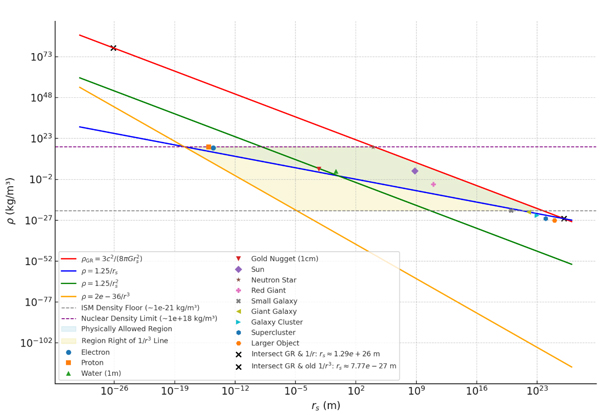
A simple $\rho \propto \frac{1}{r}$ relationship is enough to reproduce the cosmological redshift from gravitational redshift on all scales. Astronomers and cosmologists have ignored this possibility because they draw artifical boundaries around stars and galaxies.
Working directly Hubble's law I've listed the mass, density, and gravitational redshift for various cosmological scales below.
Mean Density9.6996×10−27 kg/m³ · 1.4331×10¹¹ M☉/Mpc³
# Galaxies (dwarf → giant)2.17×10¹⁵ → 4.34×10⁶
# Galaxies (~Milky Way)4.37×10¹⁰
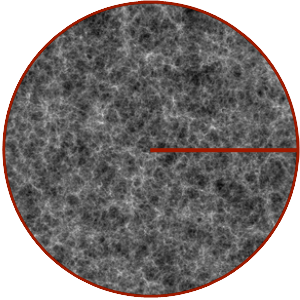
Image: your horizon overlay
There is exactly enough mass present for all scales to reproduce Hubble's law as gravitational redshift!
Core Proposal
On large scales the observable Universe is well described by a static, spherically symmetric geometry tied to an observer-dependent horizon at radius \(r_h\). A scale-dependent mass profile
\[\bar\rho(r)=\tfrac{3k}{2r},\qquad m(r)=2\pi k r^2\]
yields constant radial acceleration \(a=2\pi Gk\) and a redshift law
\[1+z=\sqrt{\tfrac{1 - r_\text{obs}/r_h}{1 - r_\text{em}/r_h}},\]
with metric coefficient
\[A(r)=(1-r/r_h)^{-1}.\]
With the observer at the origin \((r_\text{obs}=0)\), this reduces to
\[1+z=(1-r/r_h)^{-1/2},\]
and the small-\(r\) limit recovers Hubble’s law with
\[H_0=\frac{c}{r_h}=\frac{4\pi Gk}{c}.\]
Formulation
Density & mass
\[\bar\rho(r)=\frac{3k}{2r},\qquad m(r)=2\pi k r^2.\]
Metric & redshift
Static, spherically symmetric line element:
\[
ds^2 = -\frac{c^2 dt^2}{1 - r/r_h} + \frac{dr^2}{1 - r/r_h} + r^2 d\Omega^2.
\]
Redshift between emitter and observer:
\[
1+z=\sqrt{\frac{1 - r_\text{obs}/r_h}{1 - r_\text{em}/r_h}}.
\]
With \(r_\text{obs}=0\): \(1+z=(1-r/r_h)^{-1/2}\), so \(z\simeq r/(2r_h)\Rightarrow v\simeq H_0 r\).
Horizon, Hubble, acceleration
\[r_h=\frac{c^2}{4\pi G k},\qquad H_0=\frac{c}{r_h}=\frac{4\pi G k}{c},\qquad a=\frac{G m(r)}{r^2}=2\pi G k.\]
All equations on this page are standardized to the mass profile \(m(r)=2\pi k r^2\) with effective density \(\bar\rho(r)=3k/(2r)\), ensuring consistency across redshift, CMB, and BAO derivations.
The CMB as Near-Horizon Hawking Radiation
Key relations
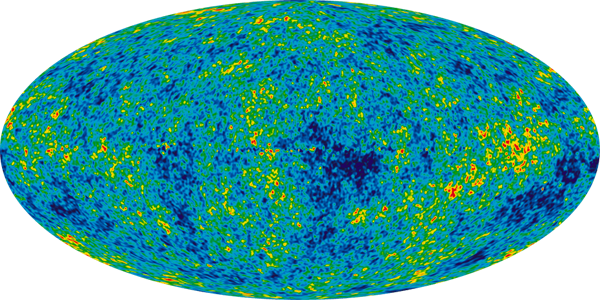
In this framework, the observed 2.725 K Cosmic Microwave Background arises from Hawking radiation emitted just inside the horizon and blueshifted on its way to us.
Hawking temperature at the horizon:
\[T_H = \frac{\hbar G k}{c k_B}.\]
For emission a small distance \(\delta\) inside the horizon \((r_\text{em} = r_h - \delta,\ \delta \ll r_h)\):
\[1+z = \left(1-\frac{r_\text{em}}{r_h}\right)^{-1/2} = \sqrt{\frac{r_h}{\delta}}.\]
The observed temperature is then
\[T_\text{obs} = T_H \sqrt{\frac{r_h}{\delta}}.\]
3. Proper sound horizon:
With sound speed \(c_s = c/\sqrt{3},\) the proper distance to the decoupling shell is
\[r_s=\frac{c}{\sqrt{3}}\,t_*=\frac{2 r_h}{\sqrt{3}}\ln(1+z_*).\]
4. Observed BAO scale:
Including the redshift factor, the observed length is
\[\lambda_{\rm obs} = r_s(1+z_*) \approx 147\ \text{Mpc},\]
in precise agreement with the measured BAO feature.
This framework also yields a fully analytic template for the CMB angular power spectrum — Sachs–Wolfe plateau, acoustic peaks at \(\ell \sim 200,400,600\), and intrinsic high-\(\ell\) damping — all without adding an empirical Silk damping term.
Galactic Rotation Curves
From the mass profile \(m(r)=2\pi k r^2\), the gravitational acceleration is scale-independent:
\[a=\frac{G m(r)}{r^2}=2\pi Gk.\]
Circular velocities then follow
\[v(r)=\sqrt{a r}=\sqrt{2\pi Gk\,r},\]
which predicts a gently rising curve \(v\propto \sqrt{r}\). This behavior matches the observed prevalence of rising rotation curves in dwarf and low-surface-brightness galaxies, and the acceleration scale \(a=2\pi Gk\) is numerically comparable to the MOND critical value \(a_0\sim 10^{-10}\,\text{m/s}^2\).